 |
|
||

|
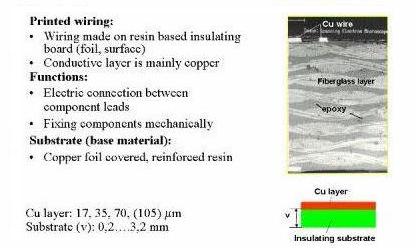
Introduction to the Technology of Printed Boards In any electronic assembly there is a special component, the substrate or circuit board which purpose is - to support and fix mechanically other components, - to interconnect the proper terminations of the components, and - to assist in the dissipation of heat generated by the components (including the heat generated by the substrate itself). The substrate is made up of an insulating base material, with conductive pattern upon and/or in it for the interconnections. In some cases the substrate also contains integrated passive elements formed from other structured layers. Printed board is the general term for completely processed printed circuit and printed wiring configurations, including single-sided, double-sided and multilayer boards with rigid, flexible and rigid-flex base materials. Both printed circuit boards and printed wiring boards provide point-to-point connections in a predetermined arrangement for mounted components, however, in a correct interpretation a printed circuit board contains also printed components on the common base material, while a printed wiring board contains only interconnection wiring. Principles and functions of printed wiring boards (PWBs)
In accordance with the everyday usage, a printed wiring board (PWB) is a substrate, which is made up of an insulating board with copper foil tracks on its outer surfaces (sometimes only on one of the outer surfaces, more often in the form of inner layers as well). The components are fixed to the PWB and connected to the conductive copper tracks by soldering. Sometimes in the technical slang the board is named printed circuit board (PCB) and the assembly is named printed circuit (PC), but these names are slightly incorrect.
|
 PWB Types and Materials