 |
|
||

|
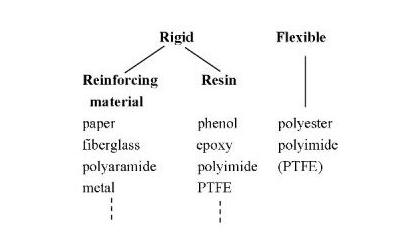
Properties and materials of printed wiring boards Printed wiring board is the general term for completely processed printed wiring configurations, including single-sided, double-sided and multilayer boards with rigid, flexible and rigid-flex base materials. For circuit cards and modules the rigid printed wiring boards are used, while flexible and rigid-flex printed wirings are popular for the interconnection of cards placed in different position in equipment or of different modules and units. Summary of base materials used for rigid and flexible PWBs
The base material, i.e. the insulating board of a rigid PWB is a sheet of laminated reinforced resin. Large majority of the laminates are produced using phenol or epoxy resins, and polyimide is also in use for advanced applications. Reinforcing materials include paper, glass cloth, asbestos, aramid, nylon, and so on. Table below provides information on the main characteristics of base materials of usual reinforcement/resin combinations. The main parameters include: the glass transition temperature, Tg, at which the amorphous polymer changes from being in a hard and relatively brittle condition to being in a viscous or rubbery condition, thus it characterizes the heat resistance of laminates; and the coefficient of thermal expansion, CTE, which value numerically describes the dimensional stability. Key properties of PWB base materials 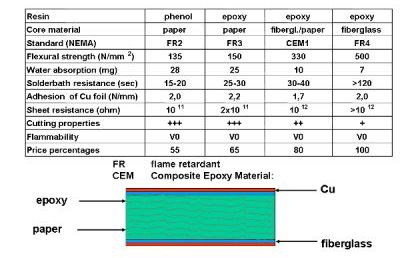
The FR-4 type epoxy-fiberglass (glass cloth) laminate is the standard for all high technology and professional electronic assemblies, as its dimensional stability and heat resistance are excellent. Polyimide resins are also used with fiberglass reinforcement for rigid PWBs, as they retain their flexural strength up to 250 oC or higher. This value is much higher than the soldering temperatures encountered, and than the 125 oC glass transition temperature for epoxy laminates. On the other hand, polyimide laminates are considerably more expensive than their epoxy equivalents. For flexible PWBs it is also the polyimide insulating material which is used without any reinforcement, or with low percentage of filler like quartz powder. In some cases photosensitive polyimide is used in order to make via formation easier and more economical. Recent developments in PWB base materials have been directed toward improving their dimensional stability and surface smoothness to allow the definition of smaller features, reducing their dielectric constant to meet the requirements of high frequency applications, and replacing glass reinforcement with laser processable materials to make laser drilling easier. Linear laminates use glass filaments for reinforcement, but instead of being woven the very thin filaments are placed parallel to form a layer and such layers are oriented alternately perpendicular one to another to make a smooth reinforcing fabric, reducing the surface roughness of the final resin impregnated insulating board. Aramid paper reinforced laminates, using paperlike nonwoven aramid fabric with epoxy resin impregnation, exhibit very good dimensional stability with near-to-silicon CTE, have a smooth surface, and can be easily processed by laser. A new class of base material is opened by the invention of resin-coated copper, where the copper foil, which serves as both supporting and reinforcing material, is covered by thin resin layers, resulting in a very thin and smooth laminate of high thermal conductivity. The boards are generally produced with one or both sides covered by a copper foil, and called copper clad laminates. The foil is produced by electrolytic plating onto a stainless steel drum slowly rotating in the liquid electrolyte. The side of the foil in contact with the drum is smooth and shiny whereas the other side is matt and granular. The thickness of the copper foil most commonly used is 17-35 µm, but for fine line circuits, in order to obtain better resolution, foils as thin as 5 µm are also in use. The adhesion of the foil to the organic reinforced prepreg (preimpregnated laminate) is achieved at the lamination stage, by pressing the granular side of the foil to the resin of the laminate and curing at increased temperature. In rigid PWBs based on polyimide insulating material, and in conventional flexible PWBs as well, an adhesive layer of acrylate or epoxy resin, is applied to bond the copper foil to the polyimide base material. Most flexible laminates used for advanced applications like laminated multichip modules (MCM-Ls), however, are based on adhesiveless polyimide films, where either a polyimide film is cast onto a copper foil (as in the case of resin-coated copper), or copper metallization, produced by the combination of vapor deposition and electroplating, is applied to a polyimide film. With the latter technology a copper conductive layer as thin as 1 µm, or even thinner, can be achieved.
|
 PWB Types and Materials